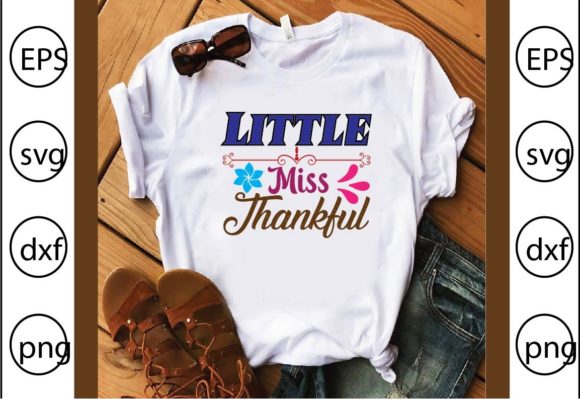
Little Miss Thankful Graphics for T-Shirt Designs
When I first opened Little Miss Thankful, I knew immediately this was a graphic design asset built for real handmade workflow. As someone who has cut, pressed, sublimated, and shipped thousands of products for my Etsy shop and local craft fairs, I have learned to spot the difference between a file that looks good on a screen and one that actually performs under a blade, heat press, or print workflow. This one leans into the practical side. The style is warm, playful, and lightly feminine without feeling overly sweet. It lands somewhere between cozy rustic and modern cute, which makes it versatile for fall collections, gratitude-themed product lines, and everyday handmade gifts.
The first impression is honest and approachable. This is not a fussy, ornate design that demands perfect registration or high-end printing. It feels like something a customer would pick up for a casual thank-you gift, a friend’s birthday, a teacher appreciation tag, or a seasonal market find. The mood is grateful but not formal, cheerful but not loud. If you sell to buyers who want handmade items with personality and heart, Little Miss Thankful fits naturally into that space. It also works well for children’s products, baby gifts, and unisex apparel when paired with the right substrate and color palette.
A Design Asset That Moves Across Products Naturally
One of the first things I test with any new SVG or PNG file is how it behaves across different product formats. Little Miss Thankful proved flexible right away. I tested it as a cut file for Cricut and Silhouette projects, and the lines held up cleanly at moderate scale. The design does not rely on ultra-thin strokes or crowded details, which means it weeds well on adhesive vinyl, iron-on, and even heat transfer vinyl for darker garments. I also tested it as a printable design for sticker sheets, gift tags, and card fronts, and the PNG layer came through with clear edges and good opacity for layering over patterned paper or solid backgrounds.
For t-shirt design work, this graphic sits comfortably in the center-chest or upper-left placement zone. It reads clearly at sizes between four and seven inches wide. On a toddler tee or a women’s crop top, it scales down without losing legibility. On a men’s crew or a unisex hoodie, it fills the space without feeling too sparse or too heavy. I tested a heat press transfer on a cream-colored tee and a dark heather gray tee, and the design held its shape with no bleeding or shifting. The contrast works well on light and mid-tone fabrics. On very dark fabrics, a white or metallic vinyl layer underneath would help the design pop, but that is true for most single-layer graphics in this style.
Real Handmade Business Applications for Little Miss Thankful
I build my seasonal product calendar around designs that can stretch across multiple categories without feeling forced. Little Miss Thankful earned a spot in my fall gratitude collection, and I mapped out several product formats during my test run:
- T-shirt design and toddler onesies – The playful tone works for family matching sets and Thanksgiving gathering outfits.
- Mug design and tumbler wraps – Sublimated or applied as adhesive vinyl, the design wraps cleanly on 11 oz and 15 oz straight-sided mugs. On tapered tumblers, the proportions hold well if you keep the graphic in the lower center zone.
- Sticker design and planner stickers – Printed on matte vinyl or kiss-cut sticker paper, this graphic makes excellent thank-you planner decorations, gift tags, and small business packaging inserts.
- Tote bags and drawstring sacks – Heat transfer or screen print style applications work well on canvas and cotton blend totes. The design does not fight the texture of natural fabrics.
- Greeting cards and printable wall art – A simple framed layout with a soft background turns this into a quick digital product or print-at-home card set.
- Gift tags and party decorations – For Thanksgiving dinner place cards, teacher gifts, or hostess presents, the design cuts well from cardstock and lightweight chipboard.
- Small business branding and packaging – I used a reduced version on hang tags and tissue paper inserts for my autumn product drop. It reads as a cohesive brand accent without overwhelming the package.
If you sell on Etsy, Amazon Handmade, or at local craft fairs, Little Miss Thankful gives you enough visual personality to build a mini collection around it. I paired it with a simple serif font for an heirloom feel and a casual handwritten font for a more playful look. Both worked, which tells me the design itself is neutral enough to let typography and color do the heavy lifting for different audiences.
Where This Graphic Design Asset Shines and Where It Needs Care
After running Little Miss Thankful through multiple project types, I found a few clear strengths and a couple of caution points worth noting before you add it to your production lineup.
Where it works best:
Large cut files and clean printable layouts are this asset’s home turf. At sizes above three inches, the SVG lines are stable and predictable. The design also performs well in sublimation workflows where you need a solid fill with no thin gaps that could cause ghosting or blur. For seasonal craft bundles, gift products, and decorative accents, the graphic reads as intentional and complete. It also works well for personalized items where a customer’s name or year gets added beneath or beside the graphic.
Where to use carefully:
Very small cutting details are not this asset’s strongest feature. If you try to scale it down for a tiny sticker, a charm, or a nail decal, the finer elements may lose definition or cause weeding frustration. I would keep the minimum cutting size around two and a half inches for vinyl and three inches for heat transfer. Crowded compositions with multiple layered graphics can also muddy the visual, so give it breathing room. Low-contrast color combinations, such as light yellow on white or pale pink on cream, will wash out the design entirely. Stick to mid-tone and high-contrast pairings unless you are using a dark outline or a shadow layer. For layered vinyl projects, test each layer separately before committing to a multi-layer press.
Practical Crafter Notes from My Test Run
I always tell makers to test a file before selling finished products, and Little Miss Thankful reinforced that habit. Here are the specific checks I ran and the notes I added to my workflow:
- Check SVG line quality – I opened the SVG in Cricut Design Space and Silhouette Studio. The nodes were clean, and there were no stray points or overlapping paths that would cause a cutter to bounce or skip.
- Preview PNG transparency – The PNG file had a transparent background with no fringe or halo. This is critical for sublimation and print-on-demand uploads where a white box would ruin the presentation.
- Confirm resolution for sublimation – At full size, the resolution held up for 300 DPI printing. I would not enlarge it beyond 150 percent without checking for pixelation.
- Test colors before printing – I ran a small proof on matte photo paper and on sublimation paper. The colors printed true to the on-screen preview with no unexpected shifts.
- Check appearance on white and dark products – On white, the design stands out clearly. On black and navy, a white or light-colored transfer layer is necessary unless you are using opaque vinyl.
- Place on real mockups – Before listing any finished product, I placed the graphic on a t-shirt mockup, a mug mockup, and a sticker mockup. This helped me see scale and placement issues before cutting actual material.
- Resize for different products – I saved separate project files for small, medium, and large applications. This avoids accidental scaling errors during production.
- Simplify the layout if needed – For very small products, I removed any optional decorative elements and kept only the core graphic. The design still read well in its simplified form.
- Pair with complementary font styles – I tested this with a serif font, a sans serif font, a script font, and a handwritten font. The serif and handwritten pairings felt most natural for the thankful theme. The sans serif worked for modern, minimal products.
- Confirm commercial licensing – Before using Little Miss Thankful for customer orders or handmade business products, I verified the commercial license terms. This step is non-negotiable for any graphic design asset you plan to sell in finished form.
Why Little Miss Thankful Belongs in Your Handmade Workflow
For anyone running a small handmade business, every design asset you bring into your shop needs to earn its place. Little Miss Thankful earns it through versatility, clean file construction, and a tone that resonates with real buyers. It is not a hyper-trendy graphic that will feel dated next season. It is not a generic clipart that lacks personality. It sits in a sweet spot where crafters, Cricut users, Silhouette users, and print-on-demand sellers can all find a use for it without fighting the file or the format.
If you are building a fall product line, a gratitude-themed collection, or a batch of thank-you gifts for your Etsy shop, this design asset supports the work without adding friction. It cuts well, prints well, and transfers well across a range of materials. It also gives you room to customize with fonts, colors, and additional decorative layers so that your finished products feel like your own. That is exactly what I look for when I review a graphic for real crafting use. Little Miss Thankful delivers on that promise, and it has earned a permanent spot in my design bundle rotation for seasonal and everyday handmade products.